
A Unique Presentation of Radial Polydactyly Beyond the Wassel Classification

https://doi.org/10.65989/928861sebsle
Article
Introduction
Radial polydactyly, a congenital anomaly characterized by duplication of the thumb, represents one of the most common preaxial limb anomalies, with an incidence of 0.08 to 1.4 per 1,000 live births [1]. The classification and surgical management of radial polydactyly remain challenging due to the heterogeneity of its presentations, particularly in cases that extend beyond classical duplication patterns.
The Wassel classification, established in 1969, remains the most widely utilized system for categorizing thumb duplications. It is based on the level of osseous duplication, ranging from Type I (bifid distal phalanx) to Type VII (duplication extending to the carpometacarpal joint). However, this system does not account for complex anomalies involving dual triphalangeal thumbs or partial phalangeal duplications. More recently, the Oberg-Manske-Tonkin (OMT) classification has been introduced to offer a developmental perspective on congenital hand anomalies, incorporating elements of malformation, dysplasia, and deformation[2]. However, even this comprehensive system does not adequately capture multicomponent duplications involving both osseous and phalangeal anomalies.
We present a unique case of polydactyly that does not conform to existing classification models, featuring a duplicated left thumb with a triphalangism in both radial and ulnar components, and the radial thumb consisting of a duplicated distal phalanx. This report aims to describe the anatomical complexity of this case and to assess the limitations of existing classification systems. By examining the shortcomings of current classification models, we emphasize the need for a more refined framework that incorporates morphological variations beyond standard duplications.

Figure 1: Preoperative x-ray of bilateral hands
Case Description
A 2-year-7-month-old female was referred to our clinic with a duplicated left thumb. The patient’s family history was positive for polydactyly, having a third-degree relative with duplication of right thumb. There were no syndromic associations, other congenital anomalies, or functional impairments at the time of examination.
Physical assessment revealed an asymmetric duplication of the thumb. Both radial and ulnar components showed triphalangism, exhibiting a well-formed extra phalanx contributing to an elongated appearance. The ulnar component had a duplicated distal phalanx, leading to an irregular digital structure. The flexion and extension functionality was preserved, but the overall aesthetic and biomechanical profile was suboptimal.
Standard radiographic imaging was conducted to determine the extent of duplication and assess skeletal morphology. X-ray imaging confirmed triphalangism in both components of the left thumb, and a duplicated distal phalanx in the medial thumb, contributing to abnormal digital architecture.
Given the complexity of the duplication pattern, a multidisciplinary surgical plan was developed, aiming for functional restoration and optimal aesthetic reconstruction.
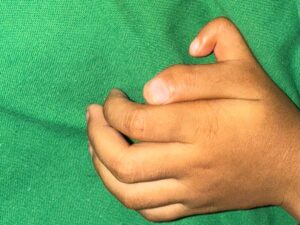
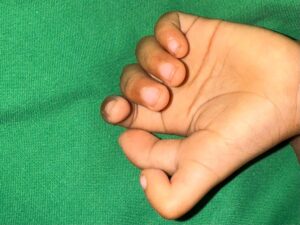
Figure 2: Hands Pre- operatively
Surgical Management
The surgical plan involved:
- Excision of the triphalangeal radial thumb, preserving essential soft tissue and neurovascular structures.
- Preservation of the dominant ulnar thumb, reshaping the distal phalanx for symmetry.
- Ligamentous reconstruction to enhance joint stability and maintain optimal thumb opposition.
The surgery was performed without complications, and structural realignment was successfully achieved
Discussion
Radial polydactyly is traditionally classified using the Wassel system, which outlines seven types of duplication based on the level of osseous division. However, this system does not account for cases that involve both triphalangeal morphology and partial phalangeal duplication. The OMT classification, introduced as an alternative framework, incorporates malformations, deformations, and dysplasias but similarly fails to capture cases that exhibit mixed structural anomalies (3). This case highlights the inadequacy of both classification systems and underscores the need for an expanded classification model that integrates:
- Triphalangeal thumb variants.
- Partial phalangeal duplication patterns.
- Complex polydactyly with combined malformation elements.
Surgical intervention for such cases must be highly individualized, focusing on: functional integrity (opposition, stability, grip strength), aesthetic symmetry (phalangeal alignment, digit length normalization), and joint and ligamentous reconstruction to optimize long-term thumb biomechanics. This case contributes to the growing body of literature advocating for a refined classification system that better reflects the diversity of congenital polydactyly cases.
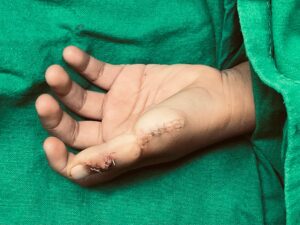

Figure 3: Hands Post Operatively
clarations
None
ORCID
Consent for publication
Informed written consent for publication and accompanying images was obtained from the patients prior to collecting information.
Availability of data and material
All data generated or analyzed during this study are included in this published article.
Competing interests
The authors declare that they have no competing interests.
Funding
The authors received no financial support for the research, authorship, and/or publication of this article.
References
References
- Manske, M. C., Kennedy, C., & Huang, J. I. (2017). Classifications in Brief: The Wassel Classification for Radial Polydactyly. Clinical Orthopaedics and Related Research, 475, 1740-1746.
- Baas, M., Zwanenburg, P. R., Hovius, S., & van Nieuwenhoven, C. V. (2016). The Application of the Oberg, Manske, and Tonkin Classification in Clinic. HAND, 11, 35S – 35S.
- Baas, M., Zwanenburg, P. R., Hovius, S., & van Nieuwenhoven, C. V. (2018). Documenting Combined Congenital Upper Limb Anomalies Using the Oberg, Manske, and Tonkin Classification. The Journal of Hand Surgery, 43(9), 869.e1-869.e11.
- Tonkin M. Thumb duplication/polydactyly. J Hand Surg Eur Vol. 2021 May;46(4):341-345. doi: 10.1177/1753193421994778. Epub 2021 Feb 24. PMID: 33626950.
- Rogers, B.H., Schmieg, S.L., Pehnke, M.E. et al. Evaluation and Management of Preaxial Polydactyly. Curr Rev Musculoskelet Med 13, 545–551 (2020). https://doi.org/10.1007/s12178-020-09644-w
- Comer GC, Potter M, Ladd AL. Polydactyly of the Hand. J Am Acad Orthop Surg. 2018 Feb 1;26(3):75-82. doi: 10.5435/JAAOS-D-16-00139. PMID: 29309292.